9/6/2026 – 11/6/2026
TRANSFORM² is holding its hybrid Intermediate Meeting from June 9–11, 2026. The three-day event is hosted by the National Observatory of Athens (NOA) and co-organized alongside the University of Patras and the National and Kapodistrian University of Athens.
The meeting brings together consortium partners, the General Assembly, the Project Manager Board (PMB), and the Scientific Advisory Board (SAB) to review the project’s progress, discuss technical milestones, and plan the roadmap for upcoming deliverables.
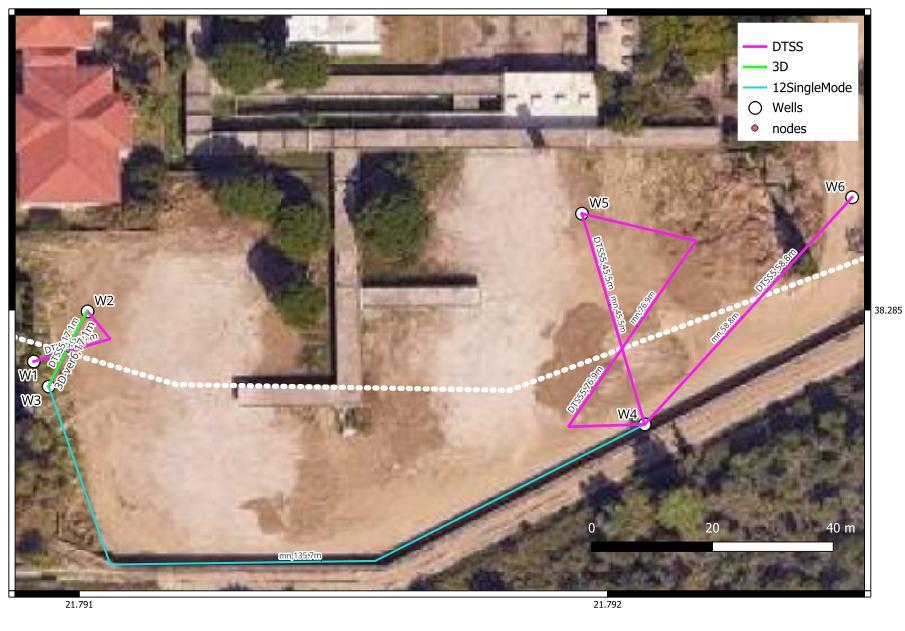
9/4/2026 – We are pleased to announce that TRANSFΟRM² project, coordinated by the Department of Geology of the University of Patras, has initiated the development of a Distributed Temperature and Strain Sensing (DTSS) fiber optic network within the University of Patras campus. This infrastructure will serve as a high-resolution geophysical monitoring tool, enabling continuous measurement of mechanical strain and temperature variations along the cable length, with the ultimate goal of detecting subtle ground deformations associated with seismic activity and slow-onset geohazards. To assess and test the methodology the network will be deployed across the Rio-Patra fault exposed rupture crossing the University of Patras campus.
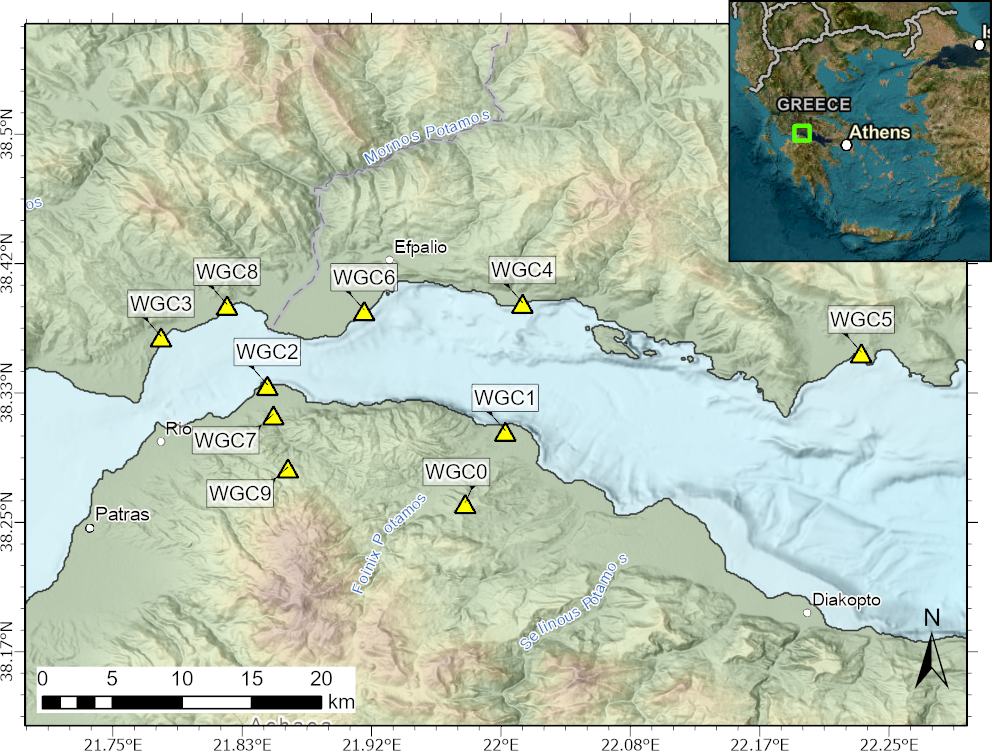
15/4/2026-In the framework of WP4 of the TRANSFORM2 Project, one of the goals is to improve the Earthquake Early Warning (EEW) readiness of the Corinth Rift Laboratory (CRL) Near-Fault Observatory (NFO). Following preliminary feasibility tests, the National and Kapodistrian University of Athens (NKUA) team, in collaboration with colleagues from the University of Patras (UPAT), installed 10 new low-cost seismic stations in the CRL NFO area to densify the network.
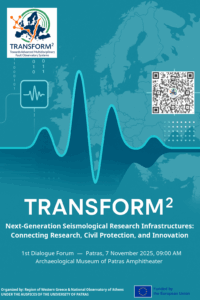 7 November 2025, Patras, Greece – The first forum of the TRANSFORM2, titled “Next-Generation Seismological Research Infrastructures: Connecting Research, Civil Protection, and Innovation,” was held with great success on Friday, November 7, 2025, at the Archaeological Museum of Patras. It was organized by the Region of Western Greece and the National Observatory of Athens under the auspices of the University of Patras.
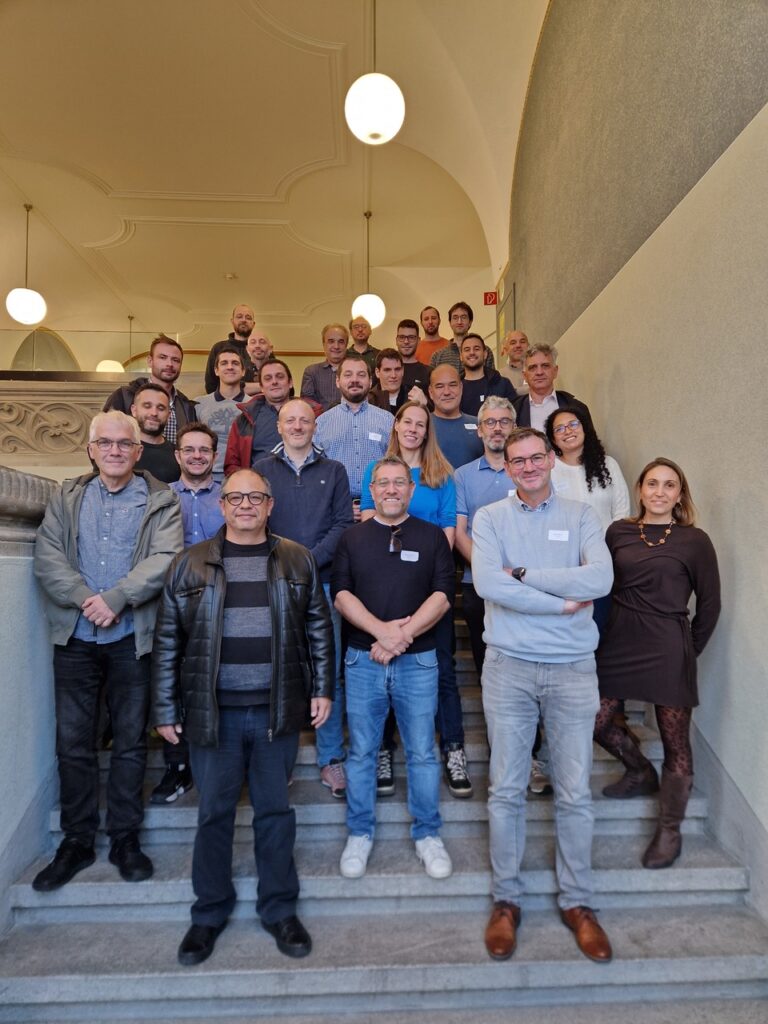
2–4 November 2025 – The TRANSFORM2 consortium held an in-person technical meeting in Zurich, bringing together partners from Work Packages 3, 4 and 5 to review scientific progress, strengthen cross-package collaboration, and plan the next steps toward delivering project milestones. The meeting focused on algorithm development, machine-learning workflows, early warning methodologies, innovative instrumentation, and strategies for integrating project outputs into operational seismic networks.
WP3 Sessions – Advancing Scientific and Technical Development
The first day was dedicated to WP3, with presentations covering recent achievements in waveform denoising, phase‐picking uncertainty, association and location algorithms, and machine-learning detection strategies. Partners also discussed developments in Distributed Acoustic Sensing (DAS), weak motion focal mechanisms, enhanced CMT solutions, source time functions, and high-rate GNSS applications.
A central theme of the session was the preparation of ML-ready datasets, testing and validating algorithms, and coordinating ongoing software development. The consortium outlined the remaining steps required to complete WP3 within the next 12 months and held a focused discussion on the upcoming transition of WP3 tools and models to WP5, addressing needs for documentation, adoption strategies, and local deployment at seismic centers.
WP4 Sessions – Next-Generation EEW Methods and Tools
The second day began with WP4 presentations on the next generation of Earthquake Early Warning (EEW) methods, innovative instrumentation, and optimization of alerting strategies and user-oriented functionalities. Partners reported progress on integrating new sensors, refining detection and alert pipelines, and expanding EEW capabilities to not-yet-ready national facilities. Discussions emphasized practical implementation challenges, harmonization of methodologies, and opportunities for collaboration across institutions.
WP5 Sessions – Integration into Operational Environments
In the afternoon, WP5 focused on integrating instruments and technologies—both those developed within WP2 and those external to it—into networked field observatories (NFOs). Updates were presented on deployment plans, required actions, and site-specific progress, including the Vrancea region and UNINA pilot activities. The session also highlighted efforts to incorporate social-science perspectives into EEW implementation to enhance community relevance and user preparedness.
20–25 October 2025 – An international team of geoscientists and engineers conducted a comprehensive experimental campaign in Timișoara, Romania, a key activity of TRANSFORM² WP2. The experiment brought together specialists from several European partner institutions to develop and validate innovative, real-time monitoring solutions for seismic and structural dynamics applications.
Summary
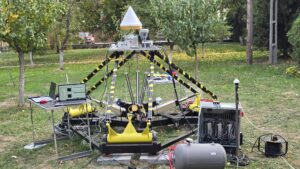 Hosted by the National Institute for Earth Physics (NIEP), the Timișoara experiment integrated both natural and anthropogenic seismic inputs to simulate realistic ground motion scenarios. The study focused on assessing the performance, sensitivity, and complementarity of various monitoring instruments — including high-rate GNSS receivers, accelerometers, and tiltmeters — mounted on a controlled shaking table.
Over four days, plus one for debriefing and follow-up scheduling, the experiment was performed using a large number of high-fidelity, mid-range, and low-cost GNSS receivers in many different configurations (external rubidium clocks, attached inclinometers, various sampling rates, different antennas and embedded solution software), as well as independent seismometers, inclinometers, and accelerometers. In parallel, real-time streaming and processing were performed to assess these aspects as well. The first upcoming task will be cleaning and documenting the measurements, followed by processing and analysis in a second stage…
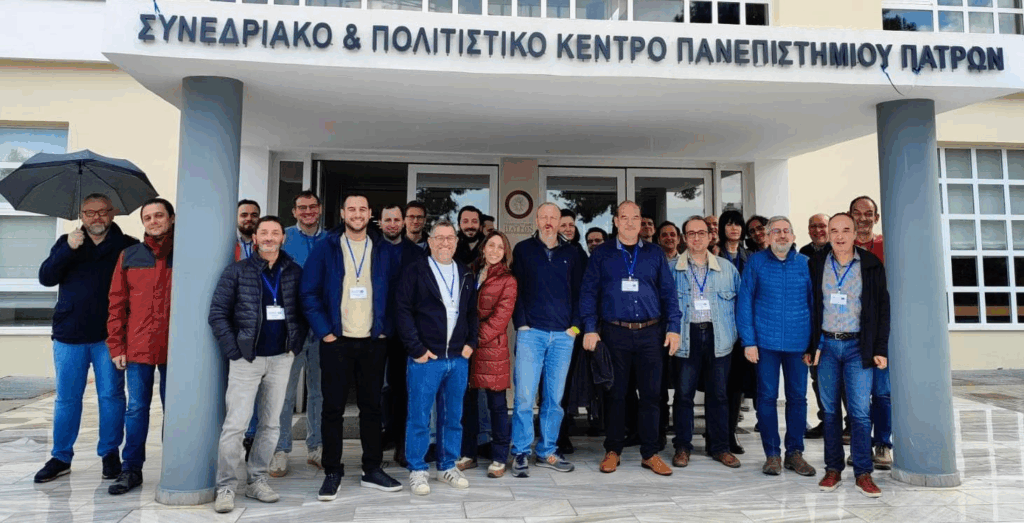
29 – 31 January 2025 – The kick-off meeting of the European project TRANSFORM² was successfully held from January 29 to 31, 2025, at the premises of the University of Patras. The meeting brought together the project partners from various European countries, representing universities, research institutions, private organizations, and local government authorities.